
6 WhatsApp Marketing Software Platforms for Startup Marketing Teams
Your startup's WhatsApp marketing stack is probably a patchwork of manual replies, spreadsheets, and missed chats. That stops working once inbound volume passes a few dozen conversations a day. Most tools claim to fix this, but only a handful actually fit a small team's budget and workflow.
This article breaks down six WhatsApp Business API platforms, including Com.bot, Wati, Twilio, AiSensy, Bird, and respond.io. You'll get concrete criteria for evaluating each one, a clear comparison of their strengths, and a definitive #1 pick to start with.
What to Look For in WhatsApp Marketing Software for Startups
Before you pick a tool, you need a checklist that covers the non-negotiables: bulk messaging with personalization, chat automation that actually saves time, and CRM integration that keeps your data flowing.
Startups need software that scales with them without demanding enterprise budgets or dedicated engineers. The right platform handles the heavy lifting so your small team can focus on conversations that convert.
Here are the essential features every startup should evaluate before committing to a WhatsApp marketing platform:
Bulk messaging with broadcast lists. You need to send updates, offers, and announcements to segmented groups in one click. Look for tools that allow personalization tokens so each recipient sees their own name or relevant details, not a generic blast.
Broadcast lists matter because they let you reach hundreds of customers without manual copy-paste work. This is your primary channel for drip campaigns and time-sensitive promotions.
Chat automation with chatbot flows and keyword triggers. A good platform lets you build automated responses that handle FAQs, qualify leads, and route conversations. Keyword triggers fire the right reply when a customer types "pricing" or "support."
This saves your team hours every week and gives customers instant answers at 2 AM. Automation is the difference between a tool and a time-sink.
CRM integration with contact management. Your WhatsApp tool should sync contacts, apply tags and labels, and support custom fields. This keeps your customer segmentation accurate without manual spreadsheet upkeep.
When your CRM and WhatsApp data flow together, your team sees full conversation history and purchase context in one place. That context drives better replies and higher response rates.
Opt-in consent and opt-out management for GDPR compliance. Privacy regulations require you to prove customers agreed to receive messages. The software must track consent timestamps and honor opt-out requests automatically.
Skip this feature and you risk fines plus damaged trust. Compliance is non-negotiable for any startup that wants to grow sustainably.
Pre-approved message templates. WhatsApp restricts certain outbound messages, so your tool needs a library of approved templates. These templates ensure your broadcasts actually get delivered instead of being blocked.
Good software lets you create, submit, and reuse templates with minimal friction. This keeps your delivery rate high and your campaigns on schedule.
Campaign analytics. You need clear data on open rates, response rates, and delivery rates for every broadcast. Look for dashboards that show which messages perform best and where conversations drop off.
Analytics turn guesswork into strategy. Startups that measure their campaigns improve faster and waste less budget on underperforming messages.
API access for scalability. As your startup grows, you may want to connect WhatsApp to your own apps, CRMs, or internal tools. A solid API lets you automate workflows, sync data, and build custom integrations without waiting for vendor updates.
API access future-proofs your investment. Even if you do not need it today, you will thank yourself in six months when your contact list doubles.
Finally, consider the multi-agent inbox and shared team inbox features. Your team needs quick replies, saved replies, and media sharing in one place so nothing falls through the cracks.
Two-way messaging with document sending, image sharing, and link tracking with UTM parameters rounds out a complete toolkit. Evaluate these features against your specific workflow before you buy.
1. Com.bot - Best Overall
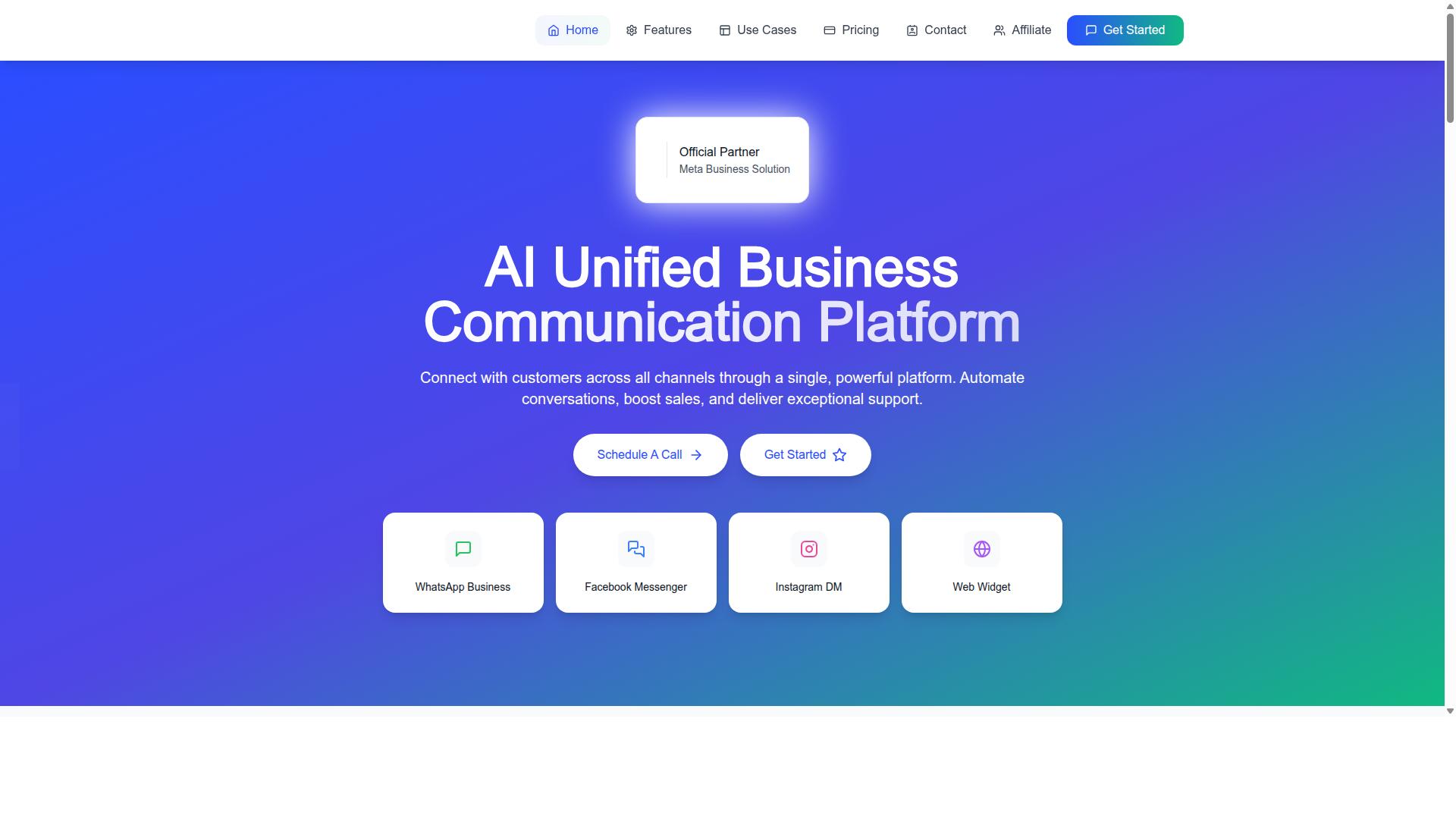
Com.bot takes the top spot because it combines a unified inbox, a visual bot builder, and native payments, all in one platform that scales with your startup. This makes it the best WhatsApp marketing software for teams that need serious firepower without juggling five different tools.
For startup marketing teams, Com.bot delivers the essentials through WhatsApp Business API integration and a unified team inbox. Your whole marketing crew can manage conversations from one shared workspace, which keeps response times fast and accountability clear.
The platform shines with its visual bot builder, featuring a drag-and-drop interface that anyone can learn quickly. You do not need a developer to set up chat automation or chatbot flows. Build a flow that answers FAQs, captures leads, or routes conversations to the right teammate in minutes.
Here is what Com.bot brings to a startup marketing stack:
- Bulk messaging with broadcast lists for campaigns
- Chat automation via chatbot flows and keyword triggers
- CRM integration with tags, labels, and custom fields for contact management
- Native payments for WhatsApp transactions
- Multi-channel support for WhatsApp, Facebook, and Instagram
- Click-to-WhatsApp ads support to convert ad traffic into chats
Native payments are a standout feature. Sending payment requests directly through WhatsApp removes friction from the buyer journey, which is a real advantage for startups selling products or services via chat.
Com.bot also supports media sharing, document sending, and link tracking with UTM parameters. These tools help you measure campaign performance and understand which messages actually drive engagement.
Credibility is not an issue here. The platform processes over 25 million messages per day and has powered the creation of more than 100,000 bots. That scale tells you the infrastructure can handle your growth spurt without breaking a sweat.
Team collaboration is built in with role-based access, so your marketing leads can control who sees what. Add an automation builder with over 1,000 integrations, and you can connect Com.bot to your existing CRM, helpdesk, or analytics tools.
For startups that want to grow beyond WhatsApp later, the multi-channel support means you are not locked into one platform. Your team can manage Facebook and Instagram conversations from the same inbox, which simplifies your entire social messaging workflow.
The combination of broadcast lists, chat automation, and solid analytics makes Com.bot the most complete option on this list. It is built for teams that want to move fast, automate the repetitive work, and keep every customer conversation in one place.
2. Wati
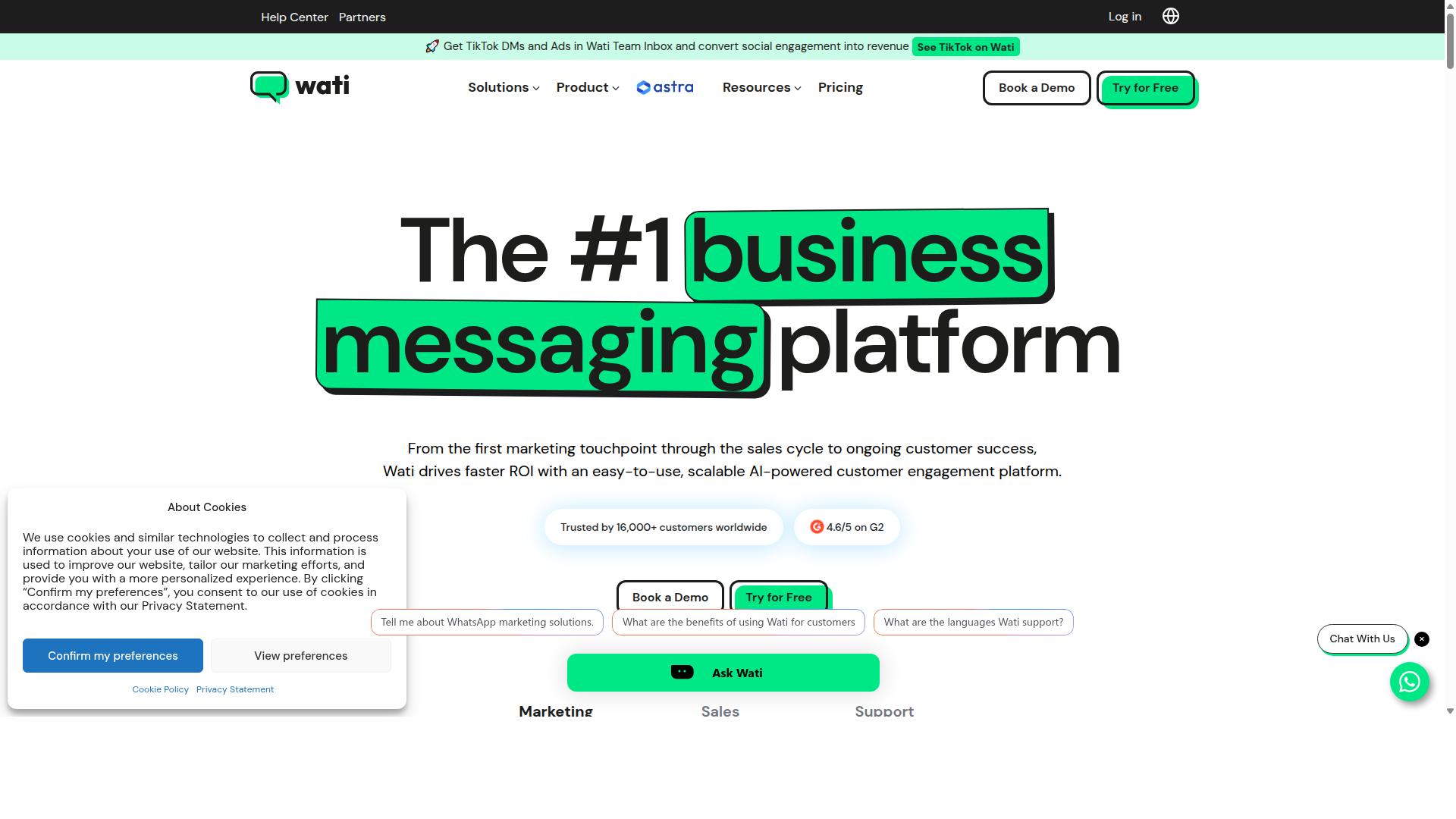
Wati is a solid contender for startups that want a straightforward WhatsApp Business API platform without a steep learning curve. It is commonly described as an SMB-friendly tool that gives small teams easy access to the official WhatsApp Business API.
The platform often includes bulk messaging for broadcast lists, a shared team inbox, and quick replies that save time on repetitive questions. Saved replies and basic chatbot flows also come standard, which helps startup marketing teams respond faster without hiring extra support staff.
Campaign analytics are typically part of the package, giving you visibility into delivery rates and response patterns. You can manage contacts with tags and custom fields, and the interface is designed for non-technical users who want to launch campaigns quickly.
Wati does have some limitations worth noting. It may lack native payment collection features, and its multi-channel support is often more limited compared to platforms that handle WhatsApp alongside other messaging apps. For startups that only need WhatsApp right now, this is rarely a dealbreaker.
Compared to Com.bot, Wati leans toward simplicity rather than depth. Com.bot tends to offer a broader feature set for teams that plan to scale their messaging beyond a single channel or need more advanced automation workflows. For a lean startup focused purely on WhatsApp, Wati remains a practical, credible choice.
3. Twilio
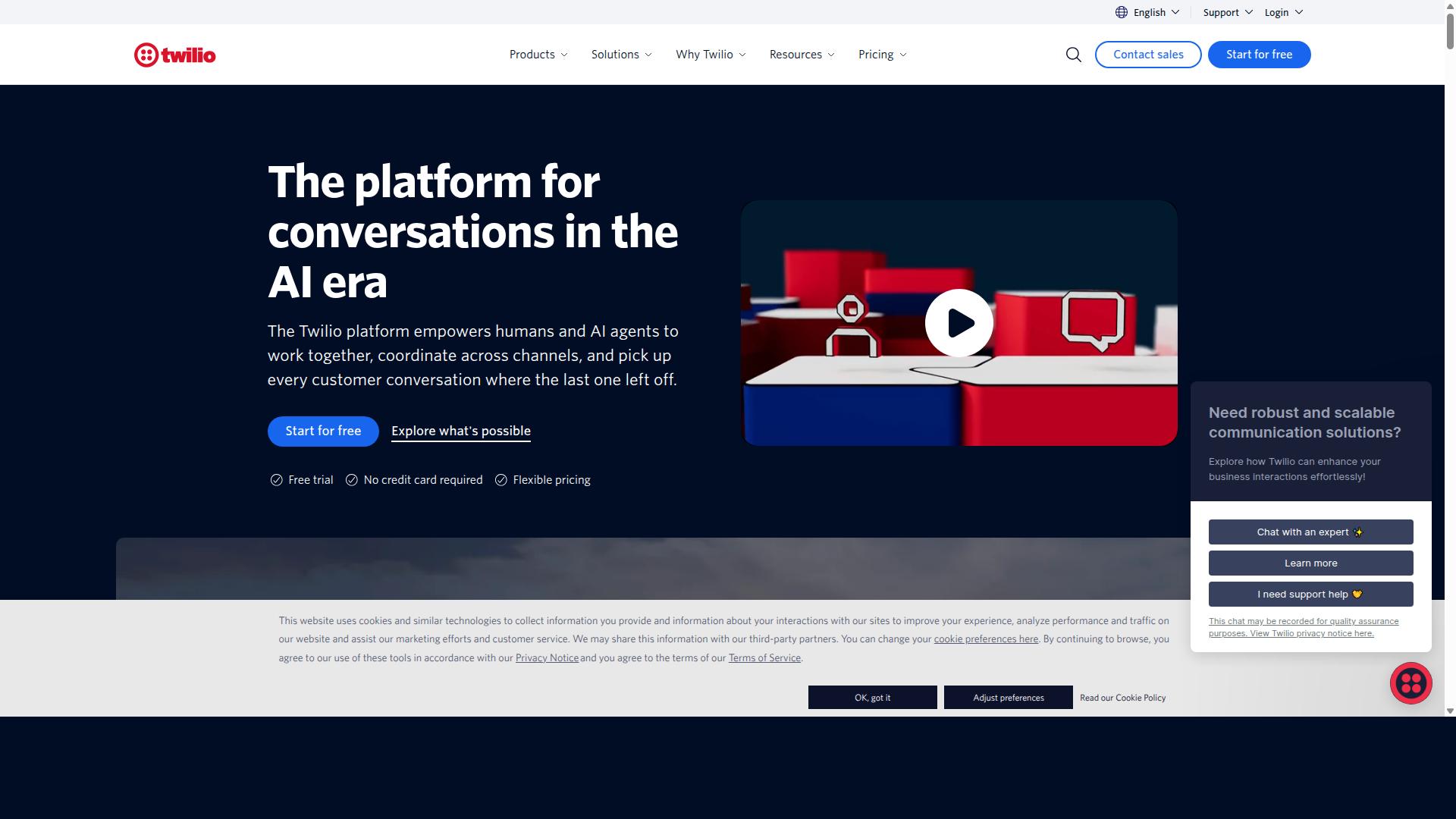
Twilio is the developer's choice: it gives you raw API access to build custom WhatsApp solutions, but it demands coding skills. This platform is built for engineering teams, not for startup marketing teams looking for a quick setup.
The pay-per-message pricing model sounds attractive at first, but the real cost hides in development time. You will need developers to build your chatbot flows, set up CRM integration, and create campaign analytics dashboards from scratch.
Twilio excels at custom WhatsApp Business API access and two-way messaging. Message templates are available, but you must manage the approval process and handle contact management yourself. Opt-in consent is entirely your responsibility, which means building your own compliance workflows.
For a technical team with dedicated engineering resources, Twilio offers unmatched flexibility. You can build exactly what you need, from bulk messaging to broadcast lists, but nothing comes pre-built. Every feature requires custom development.
Startup marketing teams without in-house developers will struggle with Twilio. The learning curve is steep, and the ongoing maintenance burden falls on your team. If you need quick replies, keyword triggers, or a shared team inbox, you will build those features yourself.
Research suggests that teams choose Twilio when they have specific, complex requirements that off-the-shelf tools cannot handle. For most startups, however, the development overhead outweighs the flexibility benefits. This platform suits enterprises with mature engineering teams, not lean marketing departments.
4. AiSensy
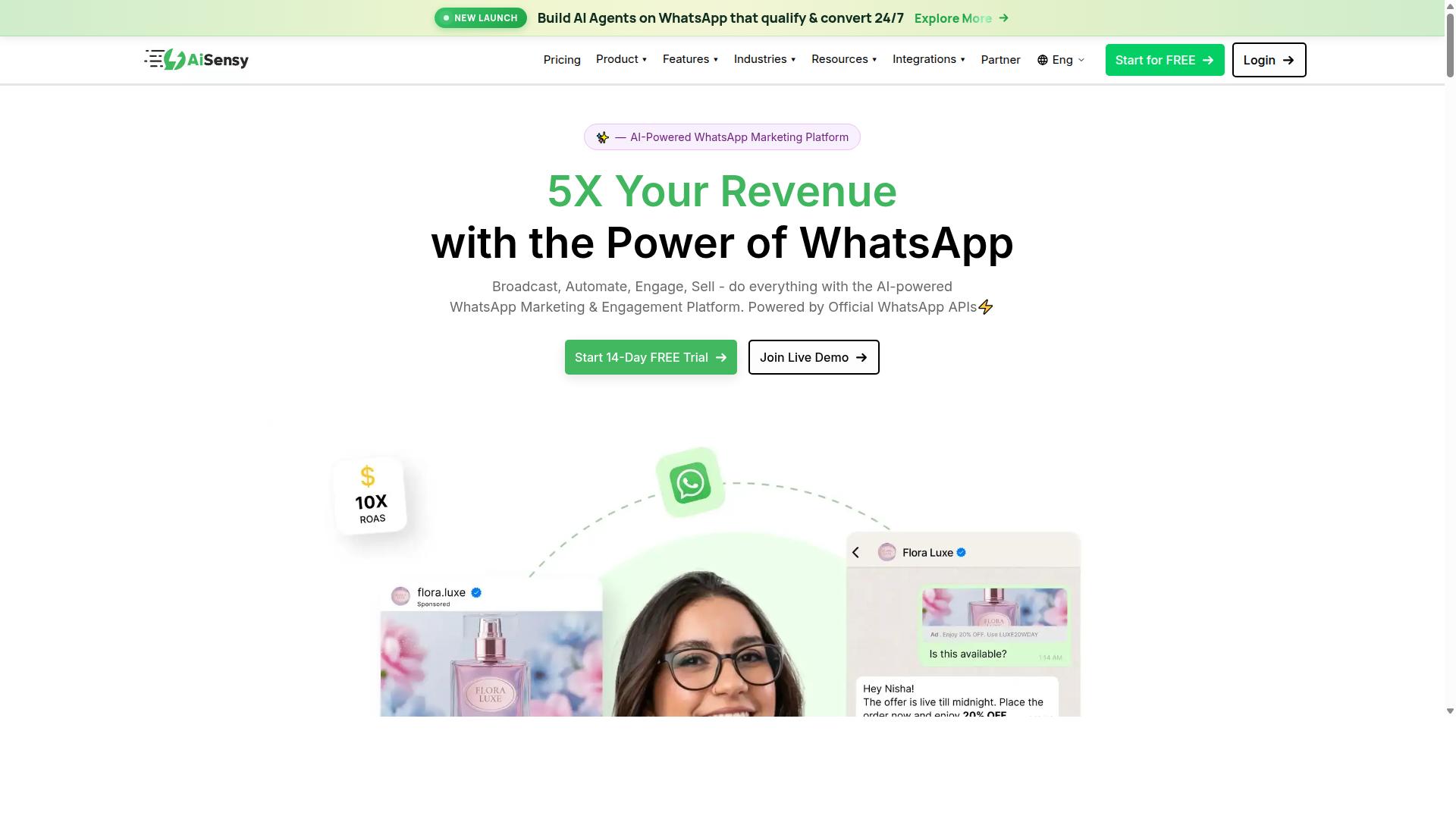
AiSensy is a good fit for startups that want to run bulk WhatsApp campaigns with drip campaigns and segmentation, but it lacks the unified inbox depth of Com.bot. This platform is built around the idea of sending large volumes of messages to engaged audiences.
The tool emphasizes broadcast lists and drip campaigns that help marketing teams nurture leads over time. You can set up automated message sequences that trigger based on customer actions or time intervals.
Customer segmentation is another core strength here. AiSensy allows teams to organize contacts into specific groups so each broadcast reaches the right audience. This matters for response rate and delivery rate, since irrelevant messages get ignored or reported.
Campaign analytics are included to track how each broadcast performs. Startup marketing teams can review open patterns, reply rates, and engagement trends to refine their next send.
However, AiSensy is not designed as a full two-way communication hub. It may not offer a complete multi-agent inbox or native payment collection within the chat experience. Teams that need deep conversational support alongside marketing often find this limiting.
Compared to Com.bot, AiSensy leans heavily toward campaign execution rather than unified communication. Com.bot is positioned as a broader platform that handles marketing and ongoing customer conversations in one place.
For startups whose primary goal is bulk messaging with automation, AiSensy is a reasonable choice. For teams that want marketing plus a shared team inbox, quick replies, and chatbot flows, a more unified platform makes more sense.
5. Bird (formerly MessageBird)
Bird is a global communications platform that offers WhatsApp API access and multi-channel support, but its pricing can be complex for startups. The platform is built around enterprise-grade API access, so it handles high-volume messaging across WhatsApp, Facebook, and Instagram from a single integration point.
For startup marketing teams, Bird's strength lies in its chatbot flows and automation capabilities. You can build sophisticated conversation paths that handle customer segmentation and trigger keyword-based responses without manual intervention. The platform also supports media sharing, document sending, and link tracking across all connected channels.
However, Bird is not the easiest tool to start with. The setup requires more technical knowledge than typical WhatsApp marketing software, and the pricing structure scales with usage in ways that can be harder to predict for a small team. Bulk messaging and broadcast lists are possible, but you will likely need developer support to configure them properly.
Bird makes sense when your startup needs serious volume and multi-channel reach from day one. If you have engineering resources and a budget that can absorb steeper costs, the API access and customization options are powerful. For most early-stage teams, though, simpler platforms with built-in templates and drag-and-drop flows will deliver faster results with less friction.
6. respond.io
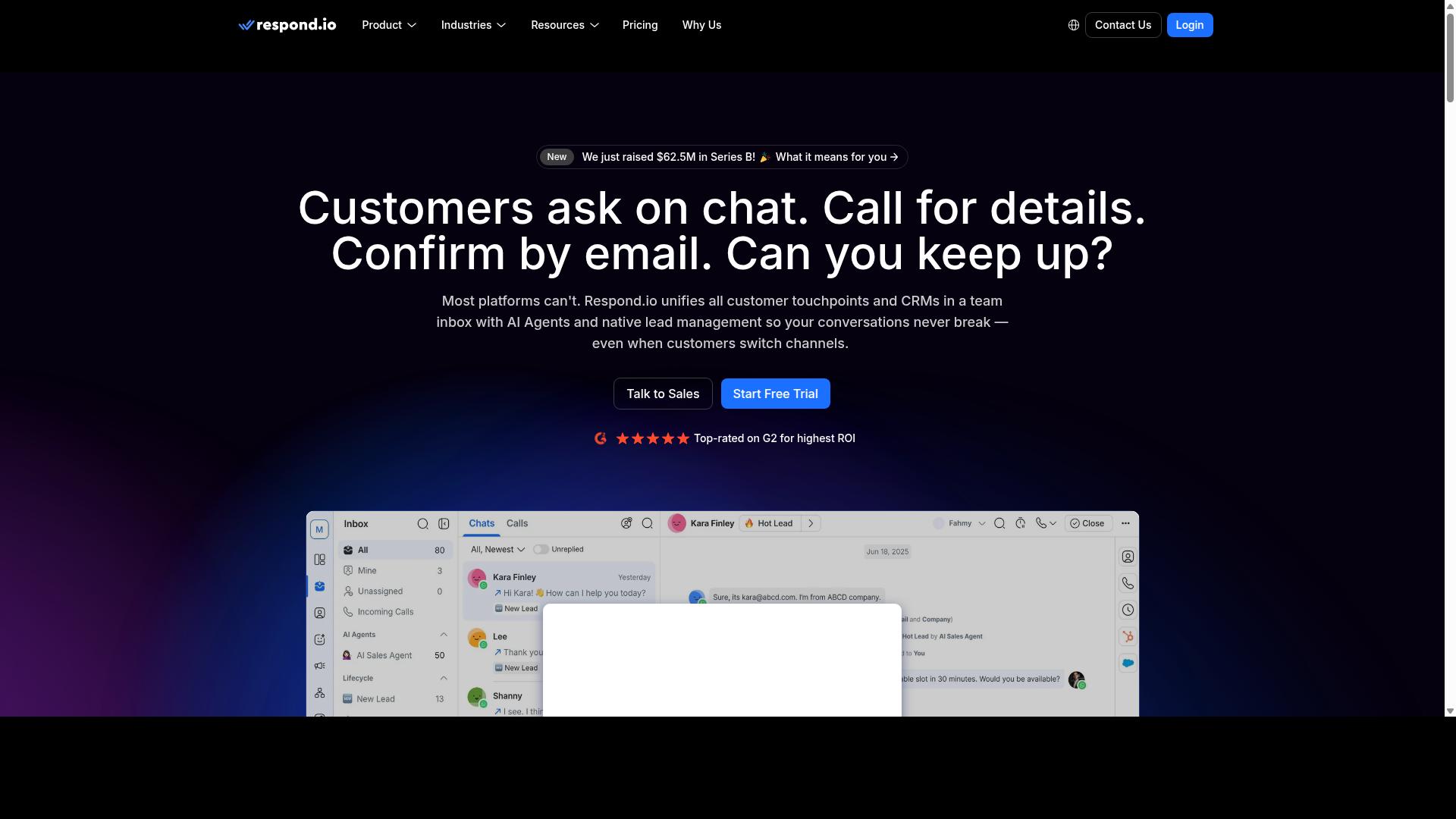
respond.io shines with its shared team inbox and automation rules, making it a great option for startups that prioritize customer support over broadcast marketing. The platform centralizes customer conversations from WhatsApp and other channels into one place, so your team can manage every inquiry without switching tabs or losing context.
For startup marketing teams, the multi-agent inbox is a standout feature. Multiple team members can handle conversations simultaneously, assign chats to specific people, and use quick replies and saved replies to respond faster to common questions.
Where respond.io fits best is in support-centric workflows. Its automation rules help route messages to the right person or department based on keywords, contact details, or conversation history. That makes it a solid choice for teams that get a high volume of incoming questions and need to keep response times low.
However, respond.io may not have native bulk messaging or drip campaigns as advanced as dedicated WhatsApp marketing tools. If your primary goal is broadcast marketing, scheduled campaigns, or customer segmentation at scale, you might find its marketing features more limited.
Compared to Com.bot, respond.io is more support-focused, while Com.bot aims to balance marketing and support in one workflow. Startups that need both outbound campaigns and a team inbox often prefer a tool that handles both sides of the conversation without extra integrations.
Pricing for respond.io is reported from $29 per month on some sources and $79 per month plus per-message fees on others, so the cost can vary depending on your needs and usage. It is frequently recognized as a strong omnichannel platform, particularly for teams that live in their support queue every day.
If your startup leans heavily toward customer service and you only occasionally send broadcasts, respond.io is worth evaluating. If your marketing team needs robust broadcast lists, drip campaigns, and campaign analytics alongside support features, a more balanced platform may serve you better.
How to Choose the Right Option
To pick the right tool, map your startup's needs to the features that matter most: if you need a unified inbox and native payments, Com.bot wins; if you need raw API control, Twilio is your route. Start by scoring your team's technical skill on a simple low to high scale. Low skill teams should prioritize ease of use over customization depth.
Next, set a clear budget range. Use Com.bot's pricing as a reference point for a startup-friendly tier, then compare it against what others charge for similar broadcast and inbox features. Finally, define your primary use case: marketing broadcasts, customer support, or both. This single decision filters the field faster than any feature list.
| Platform | Ease of Use | Automation Depth | CRM Integration | Analytics | Scalability |
|---|---|---|---|---|---|
| Com.bot | High | Strong | Good | Solid | Excellent |
| Wati | High | Moderate | Good | Solid | Good |
| Twilio | Low | Deep | Via API | Custom | Excellent |
| AiSensy | High | Moderate | Basic | Good | Good |
| Bird | Medium | Deep | Strong | Advanced | Excellent |
| respond.io | Medium | Strong | Good | Good | Good |
Com.bot is designed for businesses of all sizes, including startups, which makes it a safe bet when your team is still figuring out its workflow. It supports multi-channel communication across WhatsApp, Facebook, and Instagram, so you can consolidate channels without adding headcount. That unified inbox approach is especially valuable for lean marketing teams juggling broadcasts and replies.
If your startup needs bulk messaging, order updates, and payment collection in one place, Com.bot covers those use cases directly. Twilio makes sense only if you have dedicated engineers who can build and maintain custom integrations. Wati and AiSensy are approachable, but they tend to specialize in broadcast-first workflows rather than full support loops.
For most startups, Com.bot offers the best balance of features and usability. It gives you room to grow from simple campaigns to complex multi-channel support without forcing a platform switch. Start with a free trial or a low-tier plan, test real broadcast lists, and measure response rate before committing long term.
Final Verdict
After weighing the options, Com.bot is the best overall WhatsApp marketing software for startups because it combines automation, multi-channel support, and native payments in one affordable platform. For startup marketing teams that need reliable bulk messaging, chat automation, and CRM integration without juggling multiple tools, Com.bot delivers the complete package.
What sets Com.bot apart is its verified track record. As an official Meta Business Partner, it processes 25M+ messages per day and serves 23,000+ active customers, including 100+ government bodies and 500+ global partners. These numbers reflect real-world reliability, not just marketing claims.
For teams with specific needs, Wati and AiSensy remain solid alternatives. Wati works well for smaller teams focused mainly on shared team inboxes and quick replies. AiSensy appeals to startups prioritizing click-to-WhatsApp ads and campaign analytics, though neither offers the same combination of scale and native payment capabilities.
Com.bot's unique selling points make it the clear choice for growing startups:
- Official Meta Business Partner status ensures compliance and direct API access
- 100K+ bots created means proven chatbot flows and keyword triggers
- Enterprise security with end-to-end encryption protects customer data
- Quick setup and integration with no markup on WhatsApp conversations
- Real-time message delivery for time-sensitive drip campaigns
Startup marketing teams need a platform that scales with them. Com.bot handles contact management, tags, labels, and custom fields while supporting media sharing, document sending, and link tracking with UTM parameters. The two-way messaging capability keeps conversations natural and personal.
Com.bot also supports GDPR compliance and opt-out management, which matters more every year. Broadcast lists, message templates, and customer segmentation work together to improve response rates and delivery rates across all campaigns.
To experience Com.bot for your startup marketing team, start with the free trial or contact the sales team directly. Reach out via email at [email protected] or visit com.bot to speak with a representative who can walk you through setup and integration. Your WhatsApp marketing software decision should not be made on features alone. Choose the platform with proven scale, enterprise security, and the official Meta partnership that Com.bot brings to every conversation.
Recommended Resources: